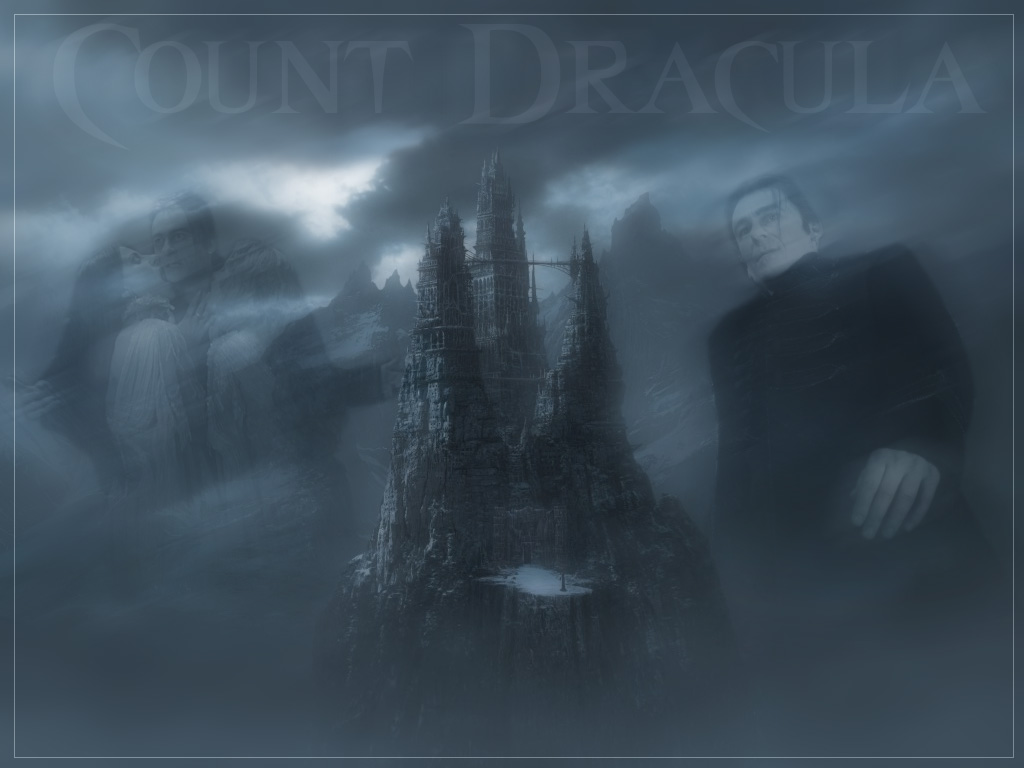
Where do vampires come from?
A perfectly legitimate questions, one might think. One many have sought to answer. But most often, said answers focus upon chronology--what events led to the undead walking among us? Here, let us examine another direction. What specific location might provide an answer? In what place did vampires arise?
That answer proves rather more important than at first seems.
Modern scientific research indicates ours is not the only universe, that an unknown number of similar or wildly different existences lie a fraction of an atom's width away from us, separated by a gulf of infinitesimal width and very nearly infinite depth. Mystics and scholars of the paranormal knew this already. In places like Sunnydale, California and Twin Peaks, Washington as well as a room in a mansion in Collinsport, Maine plus many others fissures between our reality and others can be found. Some lead to extremely similar places, populated very nearly by the people we know but leading somewhat different lives (an entire division of the FBI has become devoted to one such alternate universe). Others lead to eerie realms, some infused with light and love, while others seethe with pain and horror. The latter have been dubbed "hell dimensions" by those who study same. And they come in a wide variety indeed. There is even a second hand report of a cosmos composed entirely of shrimp.
One such hellish realm apparently has become--or perhaps always was to some extent--the domain of vampires. The heroic android known as Atomic Robo dubbed this place The Vampire Dimension. It seems a good name. Let us keep it. Careful examination of available evidence now allows for a scenario that more or less explains the nature and general history of this place.
It all goes back to what Gallifreyans called "The Dark Times" when our universe was young and the sun around which our planet orbits might not even have started burning. Many extremely predatory species arose in this ancient era, including the banished Carrionites and so-called Lonely Assassins. But perhaps most feared of all were the Great Vampires. They "came out of nowhere and swarmed...all over the universe." Vast batlike humanoids they were, capable of draining the life out of whole worlds. Among their powers were the ability to (at least sometimes) traverse universes. One such, at the end of their great war with the Time Lords, escaped into an alternate reality called E-Space. There, this creature was able to infect relatively normal human beings with vampirism.
But where did they come from? It seems clear they arose in a world or reality suited for such a race--the Vampire Dimension. Why did they leave? Perhaps their numbers grew too vast, or other forms of vampiric life competed against them rather too successfully. One real possibility remains that their reality faced invasion by supernatural vampires. As the mysterious creature called Lilith (the original, a she-demon or some such, often called the Mother of Vampires, sometimes known ironically enough as Eve) lost purchase on the reality we know, she and her blood-drinking offspring sought a new, better place. That universe they made their own. Accounts by those who've visited it indicate that once it was home to a species of humanity, virtually identical to us. Perhaps they were inter-dimensional travelers, either voluntarily or accidental (like the Telmarines) colonists in the earth-like regions. Given that we're talking about something the size of a universe, they may not have even been noticed at first. They certainly had time to build castles and cities. One castle would apparently be location a human mystic banished his son after he became a vampire (as chronicled in the motion picture Van Helsing). Interestingly, this last appeared to be in a frozen wasteland far from any human habitation. Why would anyone build a castle there?
Herein lies two clues about the nature of the Vampire Dimension. It apparently suffered some kind of ecological catastrophe, as confirmed by Atomic Robo. The castle where Vladislas Valerius was banished obviously hadn't always existed in an area where humans could not survive. One very likely scenario is that the Earth-like world where humans dwelt, probably in happy ignorance, finally attracted the attention of the vampires. Quite likely, a version of what happened next may have become the basis for the motion picture Lifeforce, which depicted the start of a gigantic disaster for the human inhabitants there. Storytellers from other worlds (such as our own) picked up on the psychic trauma of events less than a breath away, then retold what they sensed of that history--the army of batlike beings led by a beautiful, seductive female, come from the depths of space to feed upon and infect their world. Other fictionalizations of such psychic projections--demonstrating the long defeat as vampires took over that world--may include I Am Legend and Stake Land and the trilogy written by Guillermo del Toro as well as Chuck Hogan, called The Strain.
But this brings up another interesting point about the Vampire Dimension. Evidently, its timestream has very little relationship to our own. If one were to open some kind of scientific or mystic portal into that place, where it emerged in that universe's timeline is random--or at least subject to rules we do not understand. When the ensouled Turokian vampire known as Angel was banished to this realm, and emerged from it only months later in terms of our history, evidently decades if not centuries had passed for him. Yet a corollary to this would apparently be that any portal so created does not "shift" in time while it exists. It remains fixed from a point in time and proceeds from that point so long as the portal remains open. One particularly vivid example of this is the blood mirror used by the Dracula-Edgar soul-clone to insure his family's transition into full vampires. Such hints that the Vampire Dimension may well be the source of the mindless demons with which the soul is replaced in the Turokian bloodline and perhaps all vampires (in many ways undeath appears to be a physical disease whose major symptom is demonic possession). This might help explain the existence of Doomsday Cults among some factions of the undead. One suspects that the Atlantean sorcerors such as Varnae and Qu'ra whouse the Darkhold to make a new army of vampires used something like the Blood Mirror or opened a hellmouth to the Vampire Dimension.
Which brings up another aspect of the Vampire Dimension, probably the most disturbing one. Entering or exiting that realm involves a lot of effort, but people demonstrably have done it. But worse--the same thing seems to be happening from the other side! My researches indicate the Vampire Dimension seems on the verge of being used up. Much of it seems now devoid of life, drained by the various and sundry vampires that dwell there. Entire worlds have died. Consumed. Left as husks. A few areas remain relatively comfortable, even pleasant. One such I believe was the home to Lady Rawhide (aka Anita Santiago), the 19th century adventuress who became the victim of Carmelita Rodriguez, a vampire sired by none other than Dracula Prime. Sometime after the trauma of becoming a vampire, Lady Rawhide seems to have lost herself in the swirling instincts and drives of her new state. I believe she became one of the many ubiquitous Brides that Dracula (and his soul-clones) kept in various castles. Further, I believe she was pulled into the Vampire Dimension during an attempt by Dracula-Rominoff in 1897 to destroy a powerful amulet for good (as depicted in the motion picture The Monster Squad). The tellers of that tale called that realm "Limbo" but if I am right, Anita Santiago/Lady Rawhide then fell under the sway of Lilith who convinced her the girl was her daughter as part of an overall plot of Lilith's own. Anita even took a new name--Vampirella. Her memories of this place became blended in her mind with those of past life, when in a previous incarnation she was a citizen of the planet Krypton (as was the individual known as Dracula-Mordante). Along the way, it seems likely Lilith imbued 'Vampirella' with some of her own mighty power, making her invulnerable to sunlight as well as holy objects. Sometime around 1970, she then returned to Earth with muddled memories.
With this in mind, here follows a rough outline of what we can infer about the history of this parallel space/time continuum.
Like realities, what became the Vampire Dimension began much as our own. Certainly an Earth or an Earth-like world became home (one way or another) to human beings not noticeably different from ourselves. Almost certainly other species called this reality Home also. But for some reason vampiric life took hold somewhere within this universe and went unchecked. In our history, the Time Lords defeated the Great Vampires. Not so, there. In time, the plague of vampires spread. World after world fell, devoured. In the equivalent of our XXth century, the vampires came to that Earth. Even as dread Cthulhu once troubled the sensitive as He stirred in the sunken city of R'lyeh, so the onslought on that other Earth was felt in some way by artists on this one.
How long it took for that version of our world to fall we may never know. Certainly less than a century. Possibly only decades. Or years.
And once it was done, maybe the original invaders left, seeking new races and planets to fatten upon What they left behind were remnants of cities, the equivalent of New York and Hong Kong, Moscow and Jerusalem. Left to rot while the undead scrounged for victims, eventually turning upon each other. The ecology collapsed, or maybe without a high tech civilization generation global warming the next ice age came that much sooner. It hardly mattered. Eventually, that Earth no longer lived at all. Yet it wasn't dead. For vampires still roamed, still hunted one another for the blood in each others' veins. Who knows for how long...
But in that future (or what we might call the future if we shared its timeline) hungry mindless ghosts of who knows how many different vampiric entities became the only inhabitants of the ruined Earth. And in our own time, the history native to our world and universe, the horrible book known as the Darkhold was used to create a means for those demonic spirits to escape! A coven of sorcerors used that book to make a disease, a pathogen of some kind (although whether they understood that concept remains debatable) which turns a human being into the host of such a vampire ghost from that other world. Evidently, these ghosts truly are mindless. They have instincts and drives, enough to overwhelm a weak personality, but no mind as such. Victims of this terrible condition provide that, a mind which often goes insane. At least in human terms. But they aren't human any more.
Indeed, this makes the blood mirror of Dracula-Edgar an even more impressive artifact. Clearly it serves as a a portal, giving the gnawing vampire wraiths of the Vampire Dimension's future a chance to find form and identity again--from those who've gazed into the mirror and are of the right bloodline. An impressive magical achievement! Clearly the Impaler did not waste his years of study at the Scholomance!
I am indebted to the researches of Christopher Nigro and others of the MONSTAAH website and organization as well as Professor John Small for his seminal "Kiss of the Vampire" and members of the Crossover Forum on Facebook without whom this article would have proven impossible.
Showing posts with label vampires. Show all posts
Tuesday, January 3, 2012
Friday, November 25, 2011
Wolding Twilight
This is going to make some folks unhappy, but I'm finding it difficult not to include the Twilight novels into the WNU. It belongs due to a solid link noted right here by James Bojaciuk. Honestly, that some mythologists so dislike anything aimed at a primary audience of teenage girls (or whatever) to my mind simply cannot count as a factor in this.
Instead, let us examine precisely what the genuine problems of including the Twilight Saga might be.
First, the bloodline of vampires involved. Actually, this one proves pretty easy to narrow down. The Cullens (who are the vampires with whom we must deal at the moment) nearly always kill any human being they bite, but can (out of habit and rigid discipline) avoid human blood by feasting on animals. More, they suffer little or no ill effects from sunlight. In the books sunlight doesn't bother them at all, but they avoid it anyway--because they sparkle. Leave the sparkling aside, all this pretty much matches up to the Dacian bloodline to which the Karnsteins belong. Yet there remain disparities.
The Cullens are much stronger and faster and more durable than any Karnstein. More, we are told they never sleep whereas Karnsteins evidently most certainly do. And as far as we know, no other Dacian vampire sparkles. Unless we consider the question of fictionalization.
Storytellers tend to exaggerate for effect. In fact the extreme degree of personal strength and power demonstrated in Stephanie Meyer's book would seem exactly the kind of thing an author might bump up. Just as Superman went from being able to leap tall buildings to easily capable of picking up and throwing a white dwarf star, so the vampires in Forks could easily be a lot less Kryptonian. When you think on it, that detail makes zero difference to the story. Neither does the sparkling.
If we then identify the Cullens as a group of Dacian vampires who're trying to be "good" a la Nicholas Knight, the vampires of Sundown, etc. what of the other undead in the series? Who are the Volturi? Most likely some upper level members of the Myskatos Sect (as identified by Marvel Comics in The Death of Dracula) aka the Corvini Coven (so-called in the Underworld films and novels), rumor of which may have suggested the Camarilla to White Wolf Publishers, creators of the role-playing game Vampire: The Masquerade and later Vampire: The Requiem. It seems clear from these and other sources that some kind of social order exists among the undead, rather loose in structure but iron-clad when it comes to certain matters--especially allowing the bulk of humanity to realize vampires exist. Within this social structure Dracula would appear to be a monarch--preferably an absolute one but (as ever) having to contend with efforts by other undead to get away with what they can. My theory, then, is that the Volturi (named for the town where
they make a base, Volturra Italy) are the equivalent of upper level aristocrats under the vampire 'king' Dracula. Most likely their concern about Edward and Bella successfully bringing for a child stemmed (officially) from fears over the creation of yet another dhampir. These beings, such as Blade, have often proven extremely dangerous vampire hunters. Of course we also know that the leader of the Volturi hoped to "collect" some members of the Cullens for his court. In which case the Volturi 'guard' are essentially what in another context we would know as Death Dealers.
As for the other vampires in the tale, they are simply other undead of various bloodlines, pursuing their own agendas. Much is made of Forks' cloud cover, which might account for why various undead were willing to act during daylight (if indeed they did any such thing). The Wolf Tribe of shape-shifters offer no real impediment to the story's inclusion. Actually, given the Corvini centuries-long war with werewolves they justify the Volturi's reaction even further.
Having read the Rip Haywire strip used as a crossover, I must also point out the lack of anything I could call sparkling. At least I didn't spot it. But then, I can also pretty easily explain why one specific vampire might sparkle--namely his presence at an explosion near some diamond dust. The dust became embedded in his skin and there's just too much of it to feasibly remove. Voila!
And there's also a comic book called Female Force that explains how Stephanie Meyer is under the control of one of Dracula's soul-clones, in an effort to diffuse fear of the undead (Many thanks to the aforesaid Mr. James Bojaciuk for uncovering this tidbit as well as the Rip Haywire comic)! One the basis of the above, here therefore is a scenario to explain the true history behind Twilight:
We know a movement exists among some of the undead to live in harmony with human-kind. At least two of Dracula's soul-clones actually adhere to this idea (Grimpod as well as Latos). The Sutekhim Nicholas Knight as well as Turokians Angel and Spike plus the Varnean undead Barnabas Collins do as well. An entire colony of vampires in Arizona have dedicated themselves to exactly such a lifestyle (as chronicled in Sundown The Vampire In Retreat). Evidently two other covens do as well--one of rather sirenesque women who make their home in Alaska, and the wandering Cullen family, who sometimes make their haven in Forks. The Cullens are quite clearly Dacians and their sire Carlisle an elder. He personally turned four others--Edward, Esmee (who became Carlisle's mate), Rosalie and Emmett (who became a couple). In time their coven was joined by two others, Alice and her mate Jasper--evidently both Dacians and the former (like Edward) possessing extraordinary psychic gifts.
Sometime after his turning during the 1918 Influenza Epidemic, Edward left Carlisle's side seeking to hunt murderous humans. We can guess it was at this time he suffered an accident involving an explosion and diamond dust. Quite probably he returned home after this humiliation, when he became The Vampire Who Sparkles (mind you, how diamond dust might have interacted with his vampire physiology remains an intriguing question).
At one point, the Cullens encountered and made a treaty with the wolf-based shape-shifting protectors of a Native American tribe in the vicinity of Forks, Washington. Many decades later, one of this tribe fell in love with the local sheriff's daughter, Bella Swan (one suspects her father was in his youth a dirt bike racer who accidentally became his own great great grandfather due to a time travel experiment). What caused a problem was when Bella met and fell in love with Edward Cullen, and he likewise fell for her (part of the initial attraction may have been his inability to read her mind--a side effect of her father's time travel--Edward even
notes in Midnight Sun how difficult it is to "read" Bella's father).
One should note this means the fictional retelling of Charles Lyle Swann in the film Timerider (with took place five years before Bella's birth) made him seem almost twice his age at the time. Likewise, he must have been a few years older than his wife Renee rather than high school sweethearts (probably this was a projection by Stephanie Meyer, echoing her own marriage at age 21).
Leaving the details of the love triangle aside, Edward ended up marrying Bella and making her pregnant. Vampires generally are not fertile, although this might be a little less rare than it seems. Circumstances being what they are, the opportunity for non-Corvini or non-Wamphyri vampires to impregnate human women doesn't seem to happen that often. Also, just because an opportunity exists doesn't mean the woman will conceive. Yet it does happen. Sometimes. Whether Bella's status as the offspring of a time traveler (see River Song for one example) had anything to do with it remains to be seen.
Their child would be a dhampir, like the notorious vampire-hunters Blade and Eve as well as Lilith "Lilly" Munster and a few others. Coupled with the Cullens' alliance with a race of beings not unlike werewolves, this combination of events brought the attention of the Volturri, almost certainly high-level elders within the Myskatos Sect, one or more of whom might be a Corvini vampire (who have a long-standing feud/war with werewolves, their former slaves).
We don't know what precisely happened next. But Dracula Prime or one of his soul-clones saw a potential in this story to influence the mainstream of humanity. Most likely the example of Lestat's increasingly fictionalized versions (eventually becoming entirely imaginary) of his biography as written by Anne Rice served as inspiration. A Mormon housewife with some undeveloped writing talent became the focus of the Impaler's will. She even admitted in interviews to the dreams which led her to write the books. Her world-view became the lens through which she saw and related this story. Edward sparkled, so in her mind all vampires did. She herself almost certainly waited until marriage to consummate her relationship, so naturally her Bella and Edward followed suit (which may have happened in the real world as well--it remains perfectly possible). Likewise she gave to "her" characters the happy ever after ending she so ardently desired for them. Eternal happiness together, an immortal child who would mature into a young woman, reconciliation with Jacob, the Volturri in effect giving up with none of their friends having to die, etc.
But what really happened? Well, in Rip Haywire Edward seems to have a human girlfriend. But she's blonde. Poetic license? Or a hint that Bella may be no more? Where are the rest of the Cullens? It isn't as if Edward needs to spend every day with his family. On the other hand... the ending in the book really does seem too good to be true. The Myskatos as a group react very badly to disobedience or what they see as challenges to authority. Corvini elder Viktor killed his own daughter for mating with a werewolf.
We. Don't. Know. Bella and her Edward might well be raising their half-vampire child somewhere right now, along side the Cullens and a protective pack of semi-werewolves. Or the whole group may have been decimated. Or something in between. The truth, as some have said, is out there--but that doesn't mean it is always easy to find.
Instead, let us examine precisely what the genuine problems of including the Twilight Saga might be.
First, the bloodline of vampires involved. Actually, this one proves pretty easy to narrow down. The Cullens (who are the vampires with whom we must deal at the moment) nearly always kill any human being they bite, but can (out of habit and rigid discipline) avoid human blood by feasting on animals. More, they suffer little or no ill effects from sunlight. In the books sunlight doesn't bother them at all, but they avoid it anyway--because they sparkle. Leave the sparkling aside, all this pretty much matches up to the Dacian bloodline to which the Karnsteins belong. Yet there remain disparities.
![]() |
| A Karnstein vampire in sunlight |
Storytellers tend to exaggerate for effect. In fact the extreme degree of personal strength and power demonstrated in Stephanie Meyer's book would seem exactly the kind of thing an author might bump up. Just as Superman went from being able to leap tall buildings to easily capable of picking up and throwing a white dwarf star, so the vampires in Forks could easily be a lot less Kryptonian. When you think on it, that detail makes zero difference to the story. Neither does the sparkling.
If we then identify the Cullens as a group of Dacian vampires who're trying to be "good" a la Nicholas Knight, the vampires of Sundown, etc. what of the other undead in the series? Who are the Volturi? Most likely some upper level members of the Myskatos Sect (as identified by Marvel Comics in The Death of Dracula) aka the Corvini Coven (so-called in the Underworld films and novels), rumor of which may have suggested the Camarilla to White Wolf Publishers, creators of the role-playing game Vampire: The Masquerade and later Vampire: The Requiem. It seems clear from these and other sources that some kind of social order exists among the undead, rather loose in structure but iron-clad when it comes to certain matters--especially allowing the bulk of humanity to realize vampires exist. Within this social structure Dracula would appear to be a monarch--preferably an absolute one but (as ever) having to contend with efforts by other undead to get away with what they can. My theory, then, is that the Volturi (named for the town where
![]() |
| Death Dealer |
As for the other vampires in the tale, they are simply other undead of various bloodlines, pursuing their own agendas. Much is made of Forks' cloud cover, which might account for why various undead were willing to act during daylight (if indeed they did any such thing). The Wolf Tribe of shape-shifters offer no real impediment to the story's inclusion. Actually, given the Corvini centuries-long war with werewolves they justify the Volturi's reaction even further.
Having read the Rip Haywire strip used as a crossover, I must also point out the lack of anything I could call sparkling. At least I didn't spot it. But then, I can also pretty easily explain why one specific vampire might sparkle--namely his presence at an explosion near some diamond dust. The dust became embedded in his skin and there's just too much of it to feasibly remove. Voila!And there's also a comic book called Female Force that explains how Stephanie Meyer is under the control of one of Dracula's soul-clones, in an effort to diffuse fear of the undead (Many thanks to the aforesaid Mr. James Bojaciuk for uncovering this tidbit as well as the Rip Haywire comic)! One the basis of the above, here therefore is a scenario to explain the true history behind Twilight:
![]() |
| Carlisle Cullen |
Sometime after his turning during the 1918 Influenza Epidemic, Edward left Carlisle's side seeking to hunt murderous humans. We can guess it was at this time he suffered an accident involving an explosion and diamond dust. Quite probably he returned home after this humiliation, when he became The Vampire Who Sparkles (mind you, how diamond dust might have interacted with his vampire physiology remains an intriguing question).
At one point, the Cullens encountered and made a treaty with the wolf-based shape-shifting protectors of a Native American tribe in the vicinity of Forks, Washington. Many decades later, one of this tribe fell in love with the local sheriff's daughter, Bella Swan (one suspects her father was in his youth a dirt bike racer who accidentally became his own great great grandfather due to a time travel experiment). What caused a problem was when Bella met and fell in love with Edward Cullen, and he likewise fell for her (part of the initial attraction may have been his inability to read her mind--a side effect of her father's time travel--Edward even
![]() |
| The start of the Swann Clan |
One should note this means the fictional retelling of Charles Lyle Swann in the film Timerider (with took place five years before Bella's birth) made him seem almost twice his age at the time. Likewise, he must have been a few years older than his wife Renee rather than high school sweethearts (probably this was a projection by Stephanie Meyer, echoing her own marriage at age 21).
Leaving the details of the love triangle aside, Edward ended up marrying Bella and making her pregnant. Vampires generally are not fertile, although this might be a little less rare than it seems. Circumstances being what they are, the opportunity for non-Corvini or non-Wamphyri vampires to impregnate human women doesn't seem to happen that often. Also, just because an opportunity exists doesn't mean the woman will conceive. Yet it does happen. Sometimes. Whether Bella's status as the offspring of a time traveler (see River Song for one example) had anything to do with it remains to be seen.
Their child would be a dhampir, like the notorious vampire-hunters Blade and Eve as well as Lilith "Lilly" Munster and a few others. Coupled with the Cullens' alliance with a race of beings not unlike werewolves, this combination of events brought the attention of the Volturri, almost certainly high-level elders within the Myskatos Sect, one or more of whom might be a Corvini vampire (who have a long-standing feud/war with werewolves, their former slaves).
We don't know what precisely happened next. But Dracula Prime or one of his soul-clones saw a potential in this story to influence the mainstream of humanity. Most likely the example of Lestat's increasingly fictionalized versions (eventually becoming entirely imaginary) of his biography as written by Anne Rice served as inspiration. A Mormon housewife with some undeveloped writing talent became the focus of the Impaler's will. She even admitted in interviews to the dreams which led her to write the books. Her world-view became the lens through which she saw and related this story. Edward sparkled, so in her mind all vampires did. She herself almost certainly waited until marriage to consummate her relationship, so naturally her Bella and Edward followed suit (which may have happened in the real world as well--it remains perfectly possible). Likewise she gave to "her" characters the happy ever after ending she so ardently desired for them. Eternal happiness together, an immortal child who would mature into a young woman, reconciliation with Jacob, the Volturri in effect giving up with none of their friends having to die, etc.
But what really happened? Well, in Rip Haywire Edward seems to have a human girlfriend. But she's blonde. Poetic license? Or a hint that Bella may be no more? Where are the rest of the Cullens? It isn't as if Edward needs to spend every day with his family. On the other hand... the ending in the book really does seem too good to be true. The Myskatos as a group react very badly to disobedience or what they see as challenges to authority. Corvini elder Viktor killed his own daughter for mating with a werewolf.
We. Don't. Know. Bella and her Edward might well be raising their half-vampire child somewhere right now, along side the Cullens and a protective pack of semi-werewolves. Or the whole group may have been decimated. Or something in between. The truth, as some have said, is out there--but that doesn't mean it is always easy to find.
Friday, November 18, 2011
Elegant Warlords: The Corvini
I am grateful to the Underworld Wiki as well as MONSTAAH and The Crossovers Forum without which research on this article would have proven far more difficult, perhaps impossible.
Motion pictures, novels and comic books under the general heading of Underworld tell the story of a specific bloodline of the undead.
I maintain that within the (very) ficitonalized tales from Marvel Comics lie numerous hints of the Corvini, their activities and members. One obvious such, mentioned in the Curse of the Mutants storyline, must be the Myskatos Sect--a faction of vampires who embrace technology and modern business techniques, preferring to function "behind the scenes" rather than seek overt political power. Among other things they maintain a large public hospital whose high security allows members a haven as well as a source of blood. This easily corresponds with what we know of the Corvini Coven (as it is called in the motion pictures). Another bit of circumstantial evidence is the Marvel villain named Selene, a supposed mutant "energy vampire" whose lifespan extends centuries (eventually becoming the Hellfire Club's Black Queen). Although on the surface the two appear quite dissimilar, in other ways they are remarkably alike. Given Marvel's tendency to make up lurid details (see Legion of the Strange) for the purposes of story, this at least seems a possible point wherein the Corvini vampires and their faction interacted with characters established as part of the WNU.
Another example is in the character of Lady Holmwood whose fate was chronicled in the BBC 2006 production of Dracula, telling one part of the multi-pronged effort in 1909 for Dracula Prime to have his revenge against the families who thwarted him in 1887. While it is by no means conclusive, some evidence suggests that Lady Holmwood, after becoming a vampire, ended up as the concubine to Lord Kraven of the Myskatos Sect in Budapest nearly a century later (the novelization contradicts this, claiming Erica had been a vampire less than a human lifetime, but doesn't really specify what that means--making it possible that detail is a mistake)..
Far more suggestive, however, are events involving the so-called Vladislas soul-clone and the enigmatic being known as the Right Hand of God, i.e. Gabriel Van Helsing in the film Van Helsing. Elements of that story contain numerous parallels with the Corvini. Among the most obvious is that the Dracula-Vladislas (and his
three brides) showed the same startling hybrid form as Marcus Corvini--a huge humanoid bat. This, we are told, stems from the unique genetic heritage of the descendants of Hungarian warlord Alexander Corvinus. One of his sons was bitten by a vampire, another by a werewolf while a third remained human. Most humans could not become either vampire or werewolf from the bite of a Corvini, but descendants of Alexander's third child could. Dracula-Vladislas counted among his (human) relatives a young man of the Valerius family who became a werewolf of the same type of the Corvini lycanthropes (i.e. Lycans). The sister of this young man also bore a startling resemblance to the Death Dealer Selene. One is left with the strong suspicion that House Valerius descended from the immortal Alexander Corvinus (much as virtually all members of the Karnstein family have the potential to become vampires of a specific bloodline).
Then there is the television show Castle in which the title character--a successful author who has done lots of research into conspiracy theories and fringe movements as well as obscure lore--casually mentions his knowledge of the Vampire-Lycan War. Another mythologist, James Bojaniuk, also pointed out:
Another detail that bears mentioning--Alexander Corvinus was the sole survivor of a plague in 5th century Hungary. He emerged immortal from the experience, or so the story goes. Methinks this might be something of an (understandable) assumption by observers. We don't in fact know if his survival made him immortal,
only that he did in fact survive. I posit he was already immortal, or at least extremely long-lived by human standards, due to his paternal heritage. Alexander Corvinus may have been the son of the Amberite Prince Corwin, whose natural lifespan is certainly measured in centuries if not millennia. Corwin visited Earth on many occasions, once during the Black Death (which he survived, although it left him with amnesia so he wandered the world for centuries, an unaging warrior with no idea who he might be--which brings up another wild possibility, that of he or one of his Shadows being the Left Hand of God, aka Gabriel Van Helsing!). Although not particularly promiscuous, Corwin hardly could be called ascetic and we know he ended up with at least one offspring of whom he initially knew nothing. Might he have impregnated a Hungarian woman sometime in the fifth century? If so, it would help explain much of how Alexander Corvinus (note the name) came to survive that plague.
Still another--and not at all mutually exclusive possibility--remains. Corvini vampires as well as the Vladislas clone possess one extremely unusual trait--fertility. Male and female vampires of this bloodline can have children, with each other or with others. Now and then other vampires (such as the Lejos and Mordante
soul-clones) have shown the abiity to impregnate mortal women. Others have managed to do it with mystical aid (the method used by Dracula Prime). But for a vampire female to become pregnant, much less bring the child to term, hardly ever happens. Among Corvini the evidence suggests this is very nearly the norm. Indeed, since so few humans can even become Corvini vampires this might well be the primary method by which they increase their numbers! Dracula-Vladislas encountered some difficulty, but one wonders if that is not because of his unique situation. If indeed the Vladislas family are descended from Alexander Corvinus, as seems likely, it does not follow that the man eventually known as Dracula-Vladislas became a vampire of the Corvini line. He might well have been bitten by some other type of vampire and his latent genetic heritage manifested in a way that was not seen again until the early 21st century with the mutation of Marcus Corvinus (as seen in Underworld Evolution). We have no reason to suppose his 'brides' were related to the Corvinus family, so their ability to reproduce was seriously flawed, requiring help from Dr. Frankenstein to make their offspring viable (see the Van Helsing motion picture).
One more thought--also not at all exclusive to what is mentioned above. One other breed of vampires demonstrated fertility, extreme damage from exposure to sunlight (several types of vampire find sunlight harmful and/or uncomfortable only) and radical shape-shifting. I speak of the alien Wamphyri, from the alternate Earth called Starside, a handful of whom were banished to this world over the past few thousand years. One of them, perhaps not coincidentally, vanished and was presumed destroyed by pirates in the 5th century near the Black Sea. Nearly the same time and location as the plague from which Alexander Corvinus alone survived. One must wonder if there is some connection?
Motion pictures, novels and comic books under the general heading of Underworld tell the story of a specific bloodline of the undead.
![]() |
| Selene & Selene |
![]() |
| Lady Holmwood & Erika |
Far more suggestive, however, are events involving the so-called Vladislas soul-clone and the enigmatic being known as the Right Hand of God, i.e. Gabriel Van Helsing in the film Van Helsing. Elements of that story contain numerous parallels with the Corvini. Among the most obvious is that the Dracula-Vladislas (and his
![]() |
| Hybrid vampire form |
Then there is the television show Castle in which the title character--a successful author who has done lots of research into conspiracy theories and fringe movements as well as obscure lore--casually mentions his knowledge of the Vampire-Lycan War. Another mythologist, James Bojaniuk, also pointed out:
Underworld uses the exact same wolf howl from An American Werewolf in London; Underworld: Evolution uses the werewolf transformation from An American Werewolf in London. These two bits of evidence seem to say that the already-included American Werewolf in London takes place in the same universe as the Underworld series.
Another detail that bears mentioning--Alexander Corvinus was the sole survivor of a plague in 5th century Hungary. He emerged immortal from the experience, or so the story goes. Methinks this might be something of an (understandable) assumption by observers. We don't in fact know if his survival made him immortal,
![]() |
| Corwin of Amber |
Still another--and not at all mutually exclusive possibility--remains. Corvini vampires as well as the Vladislas clone possess one extremely unusual trait--fertility. Male and female vampires of this bloodline can have children, with each other or with others. Now and then other vampires (such as the Lejos and Mordante
![]() |
| Dracula-Vladislas & Brides |
One more thought--also not at all exclusive to what is mentioned above. One other breed of vampires demonstrated fertility, extreme damage from exposure to sunlight (several types of vampire find sunlight harmful and/or uncomfortable only) and radical shape-shifting. I speak of the alien Wamphyri, from the alternate Earth called Starside, a handful of whom were banished to this world over the past few thousand years. One of them, perhaps not coincidentally, vanished and was presumed destroyed by pirates in the 5th century near the Black Sea. Nearly the same time and location as the plague from which Alexander Corvinus alone survived. One must wonder if there is some connection?
Friday, October 28, 2011
The House of Karnstein (pt. 5)
The Patriarch
A big part of the history of the Karnsteins relies upon understanding who nurtured this family, and why. It all goes back to the most ancient history of the undead, probably as far back as Atlantis. According to various accounts (including Marvel Comics), at this time several sorcerors created the vampire race while attempting to fashion a new kind of weapon against their enemies. Their plan went horribly wrong. Vampires proved far too difficult to control.
In time, the oceans drank Atlantis, but some of the undead survived. These few may as well be called Antediluvians, for they pre-date the Flood which ended that continent's history and civilization. Among these were Varnae, Rasolom, Qu'ra, and the entity that in time came to be known (by some) as the Patriarch (according to legend, a much earlier female entity, usually called Lilith was also a primal vampire, perhaps THE primal vampire--it isn't clear, although the name "Lilith" came to be used much as European monarchs like calling themselves Caesar--Czar, Kaiser, etc.).
He had many names. Which even vaguely resembles his original no one probably knows. Even he may have forgotten it. But certain patterns allow us to trace a little bit of his story as he wandered across the pages of history, dripping blood as he went.
Keep in mind there's no reason to believe the Karnsteins his only breeding experiment. Quite the opposite! Evidence strongly suggests he was behind the infamous Mitterhaus family (although they may well have interbred with the Karnsteins--so many records were lost). More, central Europe in the Renaissance and early Enlightenment fairly seethed with terrible stories of decadence, blood-lust and supernatural horror. Evidence of the Patriarch's undead hand?
At any rate, by 1863 a secret castle stronghold existed for the Patriarch (now using that name/title) and a court of followers, few of whom ever set eyes upon him. What we know of this location and events there come from notes by a young vampire named Mihel Beheim, who revealed that the vampires there reveled in the fostering of certain tasteful bouquets of bloodline, among humans/peasants servicing the castle. In that year a shocking crime took place among the assembled undead (some of whom almost certainly were Karnsteins).
By 1876, the Patriarch had decided to move to America. Perhaps the number of undead in Europe made his thirst more difficult to safely manage. Or it could be this formed part of a plan to expand his supernatural power. The town of Hangman's Corners, Texas, was his target. With him came an array of demonic minions as well as an occult ring somehow connected to the Old Ones (possibly Hastur). But in the face of unexpectedly powerful magical opposition, the Patriarch (referred to by others as simply The Stranger) fled.
This was hardly his only or even first foray into the New World. A Vermont town called Jerusalem's Lot, inhabited by an offshoot of the Shakers, vanished without a trace in the 1820s--victims to a wave of unquenchable thirst by this ancient evil. In 1850 a descendant of a leader of that group uncovered evidence of vampirism and demon worship (very much resembling that of the Old Ones) among his ancestors in the nearby town of Preacher's Corners. Rather than further what he calls a "polluted bloodline" he commited suicide, but an illegitimate son moved to the town to seek to redeem the family name--Boone.
At least for a time, the Patriarch seemed to have decided at this point to foster a more direct plan to acquire power in Europe. He began to sire a group of dhampirs, human-vampire offspring (from rape in this case) then killing all the human families so as to leave his offspring nowhere else to turn. Likewise he began encouraging a variety of dark occult movements, especially in and around Germany. Such was the work of generations but he had long grown accustomed to thinking in those terms. For this aspect of his plans he took on a new name: Kagan.
The Nazi regime which Kagan (among others) helped establish furthered his long term goals admirably. Worship of death and chaos was the least of it. The SS breeding programs might well have given rise to vast numbers of potential recruits. Yet his efforts also brought forth their own failure. Hitler's Third Reich attracted the negative attentions of many groups and whole nations (including, interestingly, Dracula Prime himself). Meanwhile, Kagan's attempt to create an army of dhampirs from his loins spawned an implacable enemy--his daughter Bloodrayne. An ally of hers detonated a powerful bomb in the same room as Kagan--not killing him but wounding him severely. While his powers slowly healed him, World War Two was fought and (from his perspective) lost.
At this point, the Patriarch needed to rest and when he woke his ravaging thirst very nearly ruled him. He ended up with a loyal servant named Richard Straker. In 1973 Straker transported his master (under the alias Barlow) to the small Maine town of Salem's Lot. It seems almost certain the town was founded by servants of the Patriarch long before, with a variety of families whose bloodline allowed them to become vampires from his bite. But perhaps due to his own weakened state, or corruption from too-close interaction with Old Ones, the vampires Barlow created as he devoured the town proved nearly mindless. An erzatz band of amateur vampire hunters managed to drive a stake through Barlow's heart, then leave him in the sun. Later, they burned the town to ashes (it had gained a hideous reputation in surrounding communities). Straker, the loyal servant to the Antediluvian, had already died at his master's fangs. As far as anyone knows, that was the end of the Patriarch.
More speculative is the Patriarch's role in creation of the Corvini line of vampires, most probably by blending his own vampiric line with that of the alien Wamphyri.
The Masque of the Red Death by Edgar Allan Poe
The Vampire Virgins (unproduced sequel motion picture to Twins of Evil)
Vampire Circus (motion picture)
Metzengerstein by Edgar Allan Poe
The Golden by Lucius Shepherd
Tex Arcana (graphic novel)
The Garbage Truck by Stephen King
Jerusalem's Lot by Stephen King
Bloodrayne (video game)
Salem's Lot by Stephen King
Underworld motion pictures
Necroscope novels by Brian Lumley
A big part of the history of the Karnsteins relies upon understanding who nurtured this family, and why. It all goes back to the most ancient history of the undead, probably as far back as Atlantis. According to various accounts (including Marvel Comics), at this time several sorcerors created the vampire race while attempting to fashion a new kind of weapon against their enemies. Their plan went horribly wrong. Vampires proved far too difficult to control.
In time, the oceans drank Atlantis, but some of the undead survived. These few may as well be called Antediluvians, for they pre-date the Flood which ended that continent's history and civilization. Among these were Varnae, Rasolom, Qu'ra, and the entity that in time came to be known (by some) as the Patriarch (according to legend, a much earlier female entity, usually called Lilith was also a primal vampire, perhaps THE primal vampire--it isn't clear, although the name "Lilith" came to be used much as European monarchs like calling themselves Caesar--Czar, Kaiser, etc.).
He had many names. Which even vaguely resembles his original no one probably knows. Even he may have forgotten it. But certain patterns allow us to trace a little bit of his story as he wandered across the pages of history, dripping blood as he went.
- We know he was male.
- We know him as an ancient vampire (he even claimed to have brought about the fall of the Roman Empire).
- We know his thirst could rise to extreme levels, wiping out towns and laying waste to regions.
- We know him deeply interested in the breeding of humans, not least because he evidently had trouble turning others into vampires. Hence his ages-long efforts to foster those families (such as the Karnsteins) who could in turn become his progeny and minions.
- We know also he seemed actively Satanic or Demonic. Not merely evil in terms of selfishness and ruthless disregard of others. Worse even that cruelty. He seems something of a philosopher, an active worshiper of darkness and/or chaos.
- We also know that, unlike some (Dracula for instance) he seems content to remain totally behind the scenes, demanding abject obedience in those around him, but otherwise preferring the wielding of power over anyone's knowledge of it. This reflects in his attitude towards his (many) names.
Keep in mind there's no reason to believe the Karnsteins his only breeding experiment. Quite the opposite! Evidence strongly suggests he was behind the infamous Mitterhaus family (although they may well have interbred with the Karnsteins--so many records were lost). More, central Europe in the Renaissance and early Enlightenment fairly seethed with terrible stories of decadence, blood-lust and supernatural horror. Evidence of the Patriarch's undead hand?
At any rate, by 1863 a secret castle stronghold existed for the Patriarch (now using that name/title) and a court of followers, few of whom ever set eyes upon him. What we know of this location and events there come from notes by a young vampire named Mihel Beheim, who revealed that the vampires there reveled in the fostering of certain tasteful bouquets of bloodline, among humans/peasants servicing the castle. In that year a shocking crime took place among the assembled undead (some of whom almost certainly were Karnsteins).
By 1876, the Patriarch had decided to move to America. Perhaps the number of undead in Europe made his thirst more difficult to safely manage. Or it could be this formed part of a plan to expand his supernatural power. The town of Hangman's Corners, Texas, was his target. With him came an array of demonic minions as well as an occult ring somehow connected to the Old Ones (possibly Hastur). But in the face of unexpectedly powerful magical opposition, the Patriarch (referred to by others as simply The Stranger) fled.
This was hardly his only or even first foray into the New World. A Vermont town called Jerusalem's Lot, inhabited by an offshoot of the Shakers, vanished without a trace in the 1820s--victims to a wave of unquenchable thirst by this ancient evil. In 1850 a descendant of a leader of that group uncovered evidence of vampirism and demon worship (very much resembling that of the Old Ones) among his ancestors in the nearby town of Preacher's Corners. Rather than further what he calls a "polluted bloodline" he commited suicide, but an illegitimate son moved to the town to seek to redeem the family name--Boone.
At least for a time, the Patriarch seemed to have decided at this point to foster a more direct plan to acquire power in Europe. He began to sire a group of dhampirs, human-vampire offspring (from rape in this case) then killing all the human families so as to leave his offspring nowhere else to turn. Likewise he began encouraging a variety of dark occult movements, especially in and around Germany. Such was the work of generations but he had long grown accustomed to thinking in those terms. For this aspect of his plans he took on a new name: Kagan.
The Nazi regime which Kagan (among others) helped establish furthered his long term goals admirably. Worship of death and chaos was the least of it. The SS breeding programs might well have given rise to vast numbers of potential recruits. Yet his efforts also brought forth their own failure. Hitler's Third Reich attracted the negative attentions of many groups and whole nations (including, interestingly, Dracula Prime himself). Meanwhile, Kagan's attempt to create an army of dhampirs from his loins spawned an implacable enemy--his daughter Bloodrayne. An ally of hers detonated a powerful bomb in the same room as Kagan--not killing him but wounding him severely. While his powers slowly healed him, World War Two was fought and (from his perspective) lost.
At this point, the Patriarch needed to rest and when he woke his ravaging thirst very nearly ruled him. He ended up with a loyal servant named Richard Straker. In 1973 Straker transported his master (under the alias Barlow) to the small Maine town of Salem's Lot. It seems almost certain the town was founded by servants of the Patriarch long before, with a variety of families whose bloodline allowed them to become vampires from his bite. But perhaps due to his own weakened state, or corruption from too-close interaction with Old Ones, the vampires Barlow created as he devoured the town proved nearly mindless. An erzatz band of amateur vampire hunters managed to drive a stake through Barlow's heart, then leave him in the sun. Later, they burned the town to ashes (it had gained a hideous reputation in surrounding communities). Straker, the loyal servant to the Antediluvian, had already died at his master's fangs. As far as anyone knows, that was the end of the Patriarch.
More speculative is the Patriarch's role in creation of the Corvini line of vampires, most probably by blending his own vampiric line with that of the alien Wamphyri.
The Masque of the Red Death by Edgar Allan Poe
The Vampire Virgins (unproduced sequel motion picture to Twins of Evil)
Vampire Circus (motion picture)
Metzengerstein by Edgar Allan Poe
The Golden by Lucius Shepherd
Tex Arcana (graphic novel)
The Garbage Truck by Stephen King
Jerusalem's Lot by Stephen King
Bloodrayne (video game)
Salem's Lot by Stephen King
Underworld motion pictures
Necroscope novels by Brian Lumley
Addendum
I was one of the judges in the third Vampire Film Festival, and one of the films submitted for such was a short in which Rayne met Captain America. This is my (somewhat tenuous) basis for including Rayne and Kagan in the WNU.
Tuesday, October 25, 2011
The House of Karnstein (pt. 3)
Many Ladies, Few Names
In the annals of Karnstein, the curious tradition of naming females with an anagram of Millarca arose. Precisely why remains a mystery. Most common ended up being Millarca, Marcilla and Carmilla. Given that it seems each and every holder of these names became a vampire, one wonders if this was some kind of sign? Perhaps the family assigned such to the children destined to be the brides of their undead patron? If so, how was such chosen? A lottery? We may never know.
Millarca I journeyed from Paris to Rome in the year 1460 CE. She sought a dispensation from Pope Pius II to wed her cousin Leopold. This dispensation was only won upon Leopold agreeing to take part in a
Crusade. However, this Crusade ultimately never took place. Leopold served His Holiness faithfully and received lands as well as permission to marry Millarca. They settled there, founding an Abbey as well as the Italian branch of the Karnstein family, which interbred with the Austrian branches several times over the centuries. But Millarca I seemed destined to reincarnate again and again, ever seeking to marry Leopold once more. Her tomb was almost desecrated by a peasant's revolt in 1765, led by a local priest. Her beloved's namesake Leopold of that era hid her grave. He later became engaged no less than three times, each of his fiancees dying at Millarca's fangs before they could actually wed. Soon after the second world war, a Carmilla Karnstein became possessed by Millarca (see below).
Little is known about Mircalla I (1522-45) save that she met her final death at the blade of General Spielsdorf in 1819. Apparently, she was one of those undead who disliked her state, felt some measure of guilt over her
actions, especially the hunting down and draining of young women she first befriended. She even tried to take her last victim, an expatriate English girl named Emma, with her. Certainly this Mircalla's tomb was in Castle Karnstein, one of those few missed by Baron Hartog on his vengeful spree in the year 1794. Curiously, she apparently was under the control of an older male vampire, at least during her last active period. When finally destroyed, the portrait of her in Castle Karnstein suddenly aged and withered, becoming that of a fanged crone, then a skeleton. One must wonder if perhaps that portrait provided some means of controlling her? As to the identity of the male vampire watching over and controlling her, the most likely candidate would be the ancient undead known as the Patriarch.
Countess Mircalla III (1679-98) was woo'd and then attacked by a vampire after a ball. Many Karnstein females fall into the voluptuous blonde type, but others--like the third Mircalla--were darker, often rather exotic in appearance. A haughty young woman, she nevertheless seemed to love at least some of her victims.
As a matter of record, a former (male) lover of hers named Vordenberg hid her grave but in old age, thinking better of his actions, left instructions about where to find her. A Vordenberg descendant believed he did so, and destroyed her. In fact, Mircalla (who used the aliases Carmilla and Millarca at one time or another) had substituted a peasant girl for herself. She then wandered for many years, until finding another girl to love--in Chicago circa 1996. She turned this girl, Lauren, but she ended up leaving her maker alone in Europe. A decade or so later, Mircalla was spotted in Paris where she again fell in love, this time with an American student who came upon her feeding after midnight. At last report, they remained in Paris, which became their hunting ground. (This would be the "Carmilla" in Joseph Sheridan Le Fanu's famous novella of the same name). Evidently this lady is fascinating as well as beautiful, having won the hearts of so many in her long life.
Mircalla IV (sister to Damien Karnstein) married a Spanish nobleman in 1772. She eventually murdered him. According to legend this was because he made her do "unspeakable things." Given that two centuries later
the family has no portraits of any female ancestors, this seems believable. Exactly what happened in the aftermath of this murder is not clear, but she herself becomes a vampire. She was last heard of at the estate of her husband's family, where she seduced the the wife of the descendant of her husband as well as a schoolgirl. The husband killed all three by cutting out their hearts and was arrested. Given that Mircalla IV was only a vampire and not a vampire witch like some of her kinswomen, it seems likely this was the true death for her.
Carmilla I Karnstein was sister to the notorious Count Prospero and like him died feeding the thirst of the vampire known variously as the Patriarch or the Red Death in 1710. Either Prospero or perhaps the Patriarch
himself resurrected her in 1830 (or maybe a soul-clone of Dracula Prime, seeking to wrest control of the Karnsteins from the Patriarch). She masqueraded as a student at a local private girl's school, using the name Millarca. At that time she seduced and drained more than one of her fellow students, as well as a would be occultist professor who guessed her identity. But another teacher she entered into a relationship with, without feeding upon him. At this time, a well-armed mob attacked Castle Karnstein and burned it, leaving it a ruin. One eyewitness claimed her heart was pierced by a falling wooden beam. She may however have been resurrected at a later time, as someone matching her description and giving the name "Carmilla Karnstein" reported more than a century and a half later in the United States (and at that time serving a cult that worshiped Cthulhu). Was this the same Carmilla? Difficult to say, not least because of other such vampiresses named Carmilla.
Carmilla II (so called for convenience sake) never once gave her name as Karnstein. But circa 1850 she became part of the household of a plantation in the American South. There, typical of so many vampiresses of that family, she seduced the daughter of the house, Marie. It turned out Carmilla had visited many years earlier and turned Marie’s mother as well. Upon discovering this, the girl helped her father destroy a nest of the undead, including (eventually) Carmilla who died with Marie's name on her lips. Yet it was too late. Marie become a vampire herself. Her own eventual fate remains unknown. I do however have a theory about this specific Carmilla's identity, which makes her a Karnstein by blood but not by blood relation.
It goes back to the early 1800s, not long after the Napoleonic Wars. At that time a young woman named Carmina had just married a Captain Hans Broken. Due to a peculiar set of circumstances they ended up spending
the night at the castle of one Countess Karnstein (fictionalized as "Kronsteen"). The Countess was destroyed--but not before she seduced and turned young Carmina, after persuading her the Captain had already been unfaithful. The young lady, like the Carmilla of three decades or so later and on the other side of the Atlantic, was a doe-eyed brunette with a waif-like air. Her maker's identity remains harder to pin down, not least because as yet her first name remains unknown. However, it remains possible she also was a Carmilla (whom we might as well call III), the chosen bride of one of Dracula's soul-clones who later encountered the fourth Batman and sought to resurrect her.
Carmilla IV was certainly a Karnstein, the only daughter of Count Konstantin Karnstein, originally of the
Hungarian branch. Her grandfather had ultimately inherited the title after the main branch in Styria went extinct. She herself was raised in Italy after the first World War, with her cousin Leopold. Sadly, this led ultimately to her possession and destruction soon after the second World War ended. She discovered the hidden tomb of Millarca I, becoming possessed by that vampire and eventually killed in her name. Millarca meanwhile managed to possess Leopold's fiancee--an "unfinished business" which evidently allowed Millarca to rest in peace once her life with Leopold was done.
Yet this proved hardly the end of the story...
Blood and Roses (motion picture)
The Vampire Lovers (motion picture)
Carmilla by Joseph Sheridan Le Fanu
Carmilla: The Return by Kyle Marffin
Paris Je T'aime (motion picture)
The Blood Spattered Bride (motion picture)
The Masque of the Red Death by Edgar Allan Poe
Lust for a Vampire (motion picture)
Mall of Cthulhu by Seamus Cooper
Nightmare Classics (television film)
Lesbian Vampires Lovers of Lust (television film)
Batman Versus Dracula (motion picture)
In the annals of Karnstein, the curious tradition of naming females with an anagram of Millarca arose. Precisely why remains a mystery. Most common ended up being Millarca, Marcilla and Carmilla. Given that it seems each and every holder of these names became a vampire, one wonders if this was some kind of sign? Perhaps the family assigned such to the children destined to be the brides of their undead patron? If so, how was such chosen? A lottery? We may never know.
Millarca I journeyed from Paris to Rome in the year 1460 CE. She sought a dispensation from Pope Pius II to wed her cousin Leopold. This dispensation was only won upon Leopold agreeing to take part in a
Crusade. However, this Crusade ultimately never took place. Leopold served His Holiness faithfully and received lands as well as permission to marry Millarca. They settled there, founding an Abbey as well as the Italian branch of the Karnstein family, which interbred with the Austrian branches several times over the centuries. But Millarca I seemed destined to reincarnate again and again, ever seeking to marry Leopold once more. Her tomb was almost desecrated by a peasant's revolt in 1765, led by a local priest. Her beloved's namesake Leopold of that era hid her grave. He later became engaged no less than three times, each of his fiancees dying at Millarca's fangs before they could actually wed. Soon after the second world war, a Carmilla Karnstein became possessed by Millarca (see below). Little is known about Mircalla I (1522-45) save that she met her final death at the blade of General Spielsdorf in 1819. Apparently, she was one of those undead who disliked her state, felt some measure of guilt over her
Mircalla II died just two years after her namesake, which meant they must have been contemporaries. This lady showed little or no hesitation as far as feasting on human blood was concerned. Sometime prior to 1780 she entered into hibernation, waking only when Count Damien Karnstein dared to commit human sacrifice in an effort to raise her. She rose and lay with him, then slaked her thirst on his blood, transforming him into a vampire like herself. What happened to her afterwards is something of a mystery, although it is at least possible she and Carmilla III are the same person (see below).
As a matter of record, a former (male) lover of hers named Vordenberg hid her grave but in old age, thinking better of his actions, left instructions about where to find her. A Vordenberg descendant believed he did so, and destroyed her. In fact, Mircalla (who used the aliases Carmilla and Millarca at one time or another) had substituted a peasant girl for herself. She then wandered for many years, until finding another girl to love--in Chicago circa 1996. She turned this girl, Lauren, but she ended up leaving her maker alone in Europe. A decade or so later, Mircalla was spotted in Paris where she again fell in love, this time with an American student who came upon her feeding after midnight. At last report, they remained in Paris, which became their hunting ground. (This would be the "Carmilla" in Joseph Sheridan Le Fanu's famous novella of the same name). Evidently this lady is fascinating as well as beautiful, having won the hearts of so many in her long life.Mircalla IV (sister to Damien Karnstein) married a Spanish nobleman in 1772. She eventually murdered him. According to legend this was because he made her do "unspeakable things." Given that two centuries later
the family has no portraits of any female ancestors, this seems believable. Exactly what happened in the aftermath of this murder is not clear, but she herself becomes a vampire. She was last heard of at the estate of her husband's family, where she seduced the the wife of the descendant of her husband as well as a schoolgirl. The husband killed all three by cutting out their hearts and was arrested. Given that Mircalla IV was only a vampire and not a vampire witch like some of her kinswomen, it seems likely this was the true death for her.Carmilla I Karnstein was sister to the notorious Count Prospero and like him died feeding the thirst of the vampire known variously as the Patriarch or the Red Death in 1710. Either Prospero or perhaps the Patriarch
himself resurrected her in 1830 (or maybe a soul-clone of Dracula Prime, seeking to wrest control of the Karnsteins from the Patriarch). She masqueraded as a student at a local private girl's school, using the name Millarca. At that time she seduced and drained more than one of her fellow students, as well as a would be occultist professor who guessed her identity. But another teacher she entered into a relationship with, without feeding upon him. At this time, a well-armed mob attacked Castle Karnstein and burned it, leaving it a ruin. One eyewitness claimed her heart was pierced by a falling wooden beam. She may however have been resurrected at a later time, as someone matching her description and giving the name "Carmilla Karnstein" reported more than a century and a half later in the United States (and at that time serving a cult that worshiped Cthulhu). Was this the same Carmilla? Difficult to say, not least because of other such vampiresses named Carmilla.
Carmilla II (so called for convenience sake) never once gave her name as Karnstein. But circa 1850 she became part of the household of a plantation in the American South. There, typical of so many vampiresses of that family, she seduced the daughter of the house, Marie. It turned out Carmilla had visited many years earlier and turned Marie’s mother as well. Upon discovering this, the girl helped her father destroy a nest of the undead, including (eventually) Carmilla who died with Marie's name on her lips. Yet it was too late. Marie become a vampire herself. Her own eventual fate remains unknown. I do however have a theory about this specific Carmilla's identity, which makes her a Karnstein by blood but not by blood relation.It goes back to the early 1800s, not long after the Napoleonic Wars. At that time a young woman named Carmina had just married a Captain Hans Broken. Due to a peculiar set of circumstances they ended up spending
the night at the castle of one Countess Karnstein (fictionalized as "Kronsteen"). The Countess was destroyed--but not before she seduced and turned young Carmina, after persuading her the Captain had already been unfaithful. The young lady, like the Carmilla of three decades or so later and on the other side of the Atlantic, was a doe-eyed brunette with a waif-like air. Her maker's identity remains harder to pin down, not least because as yet her first name remains unknown. However, it remains possible she also was a Carmilla (whom we might as well call III), the chosen bride of one of Dracula's soul-clones who later encountered the fourth Batman and sought to resurrect her.Carmilla IV was certainly a Karnstein, the only daughter of Count Konstantin Karnstein, originally of the
Hungarian branch. Her grandfather had ultimately inherited the title after the main branch in Styria went extinct. She herself was raised in Italy after the first World War, with her cousin Leopold. Sadly, this led ultimately to her possession and destruction soon after the second World War ended. She discovered the hidden tomb of Millarca I, becoming possessed by that vampire and eventually killed in her name. Millarca meanwhile managed to possess Leopold's fiancee--an "unfinished business" which evidently allowed Millarca to rest in peace once her life with Leopold was done.Yet this proved hardly the end of the story...
Blood and Roses (motion picture)
The Vampire Lovers (motion picture)
Carmilla by Joseph Sheridan Le Fanu
Carmilla: The Return by Kyle Marffin
Paris Je T'aime (motion picture)
The Blood Spattered Bride (motion picture)
The Masque of the Red Death by Edgar Allan Poe
Lust for a Vampire (motion picture)
Mall of Cthulhu by Seamus Cooper
Nightmare Classics (television film)
Lesbian Vampires Lovers of Lust (television film)
Batman Versus Dracula (motion picture)
Addendum
Unreliable reports of at least one possible far future indicate a fantastically vile vampire noblewoman known as Carmilla also sought to resurrect herself following destruction. Or will seek to do so. Her efforts will be thwarted by in part by Vampire Hunter D.
Sunday, October 23, 2011
The House of Karnstein (pt. 2)
The Vampire Witches
A pattern emerges in the Karnstein family history, that of women who came to worship the forces of darkness, becoming not only witches but remarkably powerful vampires. More than once, these women survived their own homicides, lingering in spiritual form until the opportunity to be reborn presented itself. Three in particular stand out.
1. Wandessa "Satan's Favorite Mistress" Circa 1480, Countess Wandessa d’Arville de Nadasdy, age 28, was murdered by her lover after discovering she was a vampire. Wandessa had in fact been born a Karnstein and practiced all manner of black magic. The murder weapon was a silver dagger cross, made from the Chalice of Mienza. That it took an actual holy relic to dispatch her--which in the end proved insufficient--gives some idea as to her inherent power. Once the dagger had pierced her heart, she was buried in a remote part of northern France. Her epitaph read "Satan's Favorite Mistress." When accidentally revived in the 20th century by a history student named Elvira, Wandessa lost little time in seducing the young girl and turning her into a vampire [It remains possible the student in question survived the ensuing adventure and became a horror movie hostess in America]. Her next step was an attempt to open the doors between realities, allowing some vastly powerful demonic entity to come through and bring Chaos to the world. This would seem to be the same CHAOS later to prove a foil for Vampirella, and might be identified as the Lovecraftian deity Azathoth. Wandessa herself seems to have been solely attracted to women, which makes it likely the lover who managed to successfully kill such a powerful vampire-witch was one of the mystical line of Slayers. Wandessa died a second, presumably permanent, time at the claws of the werewolf Waldemar Daninsky.
2. Donia, the Other Impaler
Very nearly the same time as Wandessa fell to a silver blade, her younger sister Donia (Baroness Varga) became the first known Karnstein to fall victim to an angry mob of peasants. Like the far-more-famous Count Dracula, her cruelty often took the form of impaling those who displeased her upon a wooden stake. At last her home in a remote part of the German mountains fell to a peasants' revolt and she herself burned at the stake, her ashes scattered. Clearly her death was the work of amateurs, for this allowed the Baroness to influence the world still. Nothing sealed her in her grave, as the silver dagger did Wandessa. Rather, a malign influence in and around the castle ebbed and flowed for centuries. More than one follower/worshiper of Donia became a vampire and had to be destroyed, including a wicked old woman in the 1930s. Following the second world war, the entire area had become deserted, until two young women were lured to the castle in 1969. Donia had had a daughter, who ended up in the care of a loyal servant named Ulla Borisov, who in turn had a daughter the same age. The two young women were direct descendants of the two daughters, and the decadent cult under the control of Donia's spirit brought them together in order to incarnate herself in the flesh once more. She succeeded in possessing one of the girls, but was destroyed by an occult expert whose brother had fallen under the vampire-witch's sway.
In retrospect, one has to wonder what kind of home produced two such extraordinarily evil and rapacious women? Their lives do coincide with the construction of Castle Karnstein itself for whatever that is worth.
3. Sasha, Bane of Her Own Blood
Unlike the other two of this list, Sasha Karnstein did not marry. She lived over a hundred years after her forebears and in fact sprang from the cadet or Hungarian branch of the Karnstein family tree. Her tale was chronicled twice in different motion pictures, each changing all kinds of small details but keeping the basics intact. In this they resemble two more-or-less faithful adaptations of Dracula--that of the BBC in 1979 and the Francis Ford Coppola version in 1992. Yet apart from the peculiar details of the story which remain identical, other hints clearly show them to be the same story--not least the reference to the silver griffin which is the heraldric sigil of House Karnstein! Neither film uses her correct name, however. One dubs her Asa and the other Sera (the former also relocates the story to Moldova in the Russian Empire).
Essentially, Sasha Karnstein fell victim to an Inquisitor of the Church, her brother Gregori Karnstein. He discovered her crimes, including the worship of Satan and the practice of vampirism, and oversaw her execution. She leveled a curse upon him and his descendants, vowing to return. He evidently took precautions, nailing an iron mask upon her face and sealing her casket with a cross to hold her there. This was April 23, St. George's Day, 1660 CE. According to legend, exactly one hundred years later she sought to escape her grave but failed. Masha Karnstein, her physical twin, died that very night mysteriously.
At this point something truly strange--but for Sasha, fortunate--happened. One of Dracula's soul clones, dubbed Mordante (who would later encounter Vampirella), suffered pretty clearly from what we would call bipolar personality disorder. His lair in Transylvania lay near the Borgo Pass, in an abandoned asylum once used as a kind of 'blood farm' by Dracula Prime and/or his get. But Mordante, emotionally unstable, somehow got ahold of some notes by one of the Van Helsing family speculating about Dracula's many appearances. Taking these theories as gospel, Mordante decided he needed to resurrect "Dracula's Daughter" to be fully himself again. Either he himself or his servants stole the mummified corpse of Sasha Karnstein, intending to resurrect her in a blood ceremony. However, having fallen in love with the woman whose sacrifice was to be the heart of this ritual, Mordante let her go. Instead, he tossed Sasha's coffin into the river and destroyed the other vampires he had created there.
I date this event to 1909, in terms of how the characters have heard of Count Dracula (making it well after 1897 when Stoker's novel saw publication) but also due to events surrounding the somewhat convoluted life of Mordante (who at one point ended up stranded in his own past).
Sasha Karnstein's body was found by a doctor who soon fell under her power. Although lacking (as yet) a body with which to fully reincarnate, Sasha proved fully capable of killing most of the young females of her despised brother's family, including Tilda daughter of Franz Karnstein.
Now by this time the Styrian title had gone to the Hungarian branch, by then headed by one Count Ludwig (circumstantial evidence indicates his mother was English, of the same family that gave rise to the Dracula soul-clone known as Denrom). He had two children, Konstantin and Katia. This latter was the physical twin of Sasha. More she possessed psychic gifts. In her dreams she saw her young cousins dying one by one, saw herself as the guilty party, and began to believe herself somehow damned. A young doctor staying at her father's castle tried to comfort her, but to little avail. Then Sasha's astral form--insubstantial but real to mere human senses--infiltrated the household as a beautiful stranger. Slowly she began to feed upon Katia, initiating the process that would allow her to possess the living girl's body and live again. The young doctor, following clues in the family portraits at the castle, eventually tracked down Sasha's grave, destroying it. He believed he'd saved his love.He was wrong. Not knowing precisely how to destroy a vampire-witch like Sasha Karnstein, he merely delayed her. Katia married her seeming savior, until the taint within her grew too strong and she consumed his life's blood. Rather than threaten her brother Konstantin and his family (his daughter Carmilla would run afoul of a another vampire soon after WWII), Sasha fled to America. There she found a small town called Astaroth that she slowly converted into her own personal territory, eventually having to fight off an attempt by Orlockians to take it over. In this she found herself behaving more and more like the long-dead Sasha, even as she changed her name to Lemora.
The 1973 film that chronicled a portion of this story noted how "Lemora" became entranced by a girl named Mary Jo, who ultimately died without becoming herself undead. While the film indicates Mary Jo died sometime in the 1890s in fact she must have died between 1910 and 1920. Sometime before 1933 (the end of Prohibition) another beautiful girl child came to Astaroth, named Lila. Her appearance coincided with the final battle between Lemora's vampires and the Orlockians. Lila herself accidentally removed the wooden stake with which Lemora had been defeated, leading to her own victimization. Unlike Mary Jo, she did become a vampire. Parenthetically, it seems more than likely Lila come to the town of Los Alamos New Mexico in 1983 where she was responsible for several murders, yet evidently fell in love with a twelve-year-old mortal lad named Owen. They left the small town together. By then Lila, like many undead who move around a great deal, had changed her name, to Abby.
Katia/Lemora on the other hand would seem to have taken another name in the interim, that (ironically) of Diana Le Fanu who lured both men and women into her arms to feed upon their blood. Her lair in the 1970s had become a ranch in the Southern California desert, which made preying upon the swingers of that era so much easier.
By the 1980s she was on the other side of the continent, hunting and seducing in New York City under yet another name--Rachel. Interestingly, her prey still only sometimes turned into vampires themselves (although one memorable victim named Peter came to believe he was undead).Werewolf Shadow (motion picture)
Buffy the Vampire Slayer (t.v. series, comics, novels)
Vampirella (comic book)
The Devil's Plaything (motion picture)
Lust for a Vampire (motion picture)
Vampyr (motion picture)
Mask of Satan (motion picture)
Dracula's Great Love (motion picture)
Crypt of the Vampire (motion picture)
Lemora (motion picture)
Let Me In (motion picture)
The Velvet Vampire (motion picture)
Vampire's Kiss (motion picture)
Addendum
The above clearly disputes some of the conclusions of Mr. John Small in his seminal work Kiss of the Vampire, in which he traces the life and undeath of Vampirella. However, for the record, I totally agree with primary point, the identification of that lady with the 19th century adventurer Lady Rawhide. I have my own theory about what this individual was doing between her falling victim to Carmelita and her appearance circa 1969 as the aforementioned "Vampi."
Labels:
abby,
asa,
azathoth,
chaos,
karnstein,
le fanu,
let me in,
lila,
owen,
sera,
vampirella,
vampires,
velvet vampire,
werewolf,
witchcraft,
witches,
wold newton
Subscribe to:
Posts (Atom)